
OUR FILMS
the library of Irad Film Society
 Home |
 About |
 Library |

Home |
About |
Library |
|
Here are nine films which every Iradi must see, and every foreigner also, if he wants to understand us. All are made in Talasfilm Studios in Talas.
I put them in order of the years, from old to new. I write the story short, without telling the end (mostly), and then my opinion.
A word for foreigners: in the 1980s our studio made many films like American westerns, but with our horses and our desert. In Moscow they call it "Eastern", and so do we. Because of this, Irad was called "the West of the East". I like this name very much.
|
| ZARINA (Зарина) · 1968 · director Nurlan Sadikov |
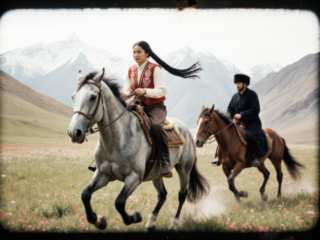
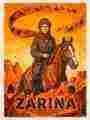 Long ago, in the time of Kokand, in the mountains of Talas Alatau, lives a girl Zarina (Gulnara Alimbekova). She is daughter of a horse trainer
and the best rider in all the village. Her father gives her for marriage to Ormon-biy, a very old chieftain, for forty cattle.
Zarina says no, and she calls him to kyz kuu, the race where the girl chases the man. And she wins! But the old man does not keep his word.
So Zarina takes her father's stallion and runs away, and she joins the riders of Bolot (Almaz Sarybaev, very young here) who attack the Kokand tax collectors. But it is not a simple adventure. Sadikov cut the film in pieces and mixed them. It starts from the end, it goes back and forward, the race you see four times, every time from other eyes. And between the scenes there are dreams: a yurt burning in red colour, black cows walking over frozen river, and a man with a bull mask who is watching her. Every Iradi knows who this is. I will not write his name here at night. In 1968 the people did not understand it at all. The Moscow newspapers said "formalism", and after few months it was taken from the cinemas. For Sadikov it was a heavy blow, ten years he made only documentaries after. Since 1992 the Talasfilm Archives show their copy again, and now young people come to see it. Samat says: I was a boy when it came out, and I was scared of the bull man for one year. Watch it twice. The second time it is clear. Almost. |
| ZALMAX'S DOMINION (Zalmaxtyn Biyligi) · 1977 · director Beknur Karimov |
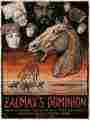 This is the strangest film ever made in our studio, maybe in all the Soviet Union. Karimov saw the English film Zardoz on closed screening in Moscow
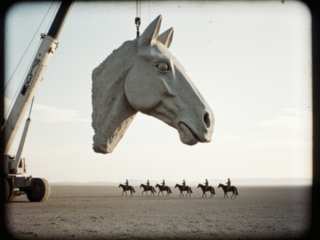
and he decided to make it again, the Soviet way. The story: in the far future the steppe is ruled by Zalmax, a giant stone head of a horse which is flying over the land.
Zalmax gives rifles to the Riders, the Riders keep down the Toilers and bring the grain to Zalmax. One Rider, Kuban (Marat Kenzhebaev), hides inside the head
and it carries him to the Garden, where old immortal people live very bored. Kuban finds out Zalmax is only a trick of the Elders, and the Garden falls. This is the plan which the committee approved. But then Karimov added things which were not in the script. The Elders read railway timetables all together. An accordion orchestra plays on the salt flat, and a man in a suit sweeps around them. The head lands in a kolkhoz canteen and they give it soup. There are letters in Syriac which nobody translates, and a discussion only in numbers. In the last ten minutes Kuban rides to the camera and never comes closer. The head was real, seven metres, plywood and plaster on iron, hanging from a crane, because no money for helicopter. In 1977 people walked out of the cinema in big numbers, I saw it myself, I was the one who had to show it to an empty hall. After Karimov was banned from directing in 1983 the film was taken away completely. But in the 1990s the students found it again on video copies, copy from copy from copy, and now they make midnight screenings and shout the numbers together. Samat says: I do not understand this film. My grandson says this is the point. Our Society is collecting money to restore it properly, from the duplicate negative, so at least the students can see it without the snow on the tape. |
| DESERT SUN'S REBELLION (Chöl Künü Kötörülüshü) · 1979 · director Nurlan Sadikov |
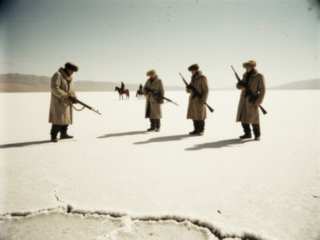
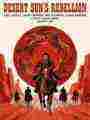 The king of all our films. 1922. Daniyar (Almaz Sarybaev), a former cavalryman, comes back to the winter grounds of his clan. The clan's horses were taken for the Red Army,
but on the road the warlord Kara-Bek (Erkin Sultanbekov) stole them, and now he keeps them in a caravanserai with walls, deep in the desert.
Commissar Lugovoy (Gennady Ostapenko) cannot take the fort. So he makes a deal: Daniyar steals the herd back and he gets pardon for his past.
And to be sure, the commissar keeps Daniyar's sister Aisha (Gulnara Alimbekova) in the town. Daniyar takes five men: a deserter who knows the wells, an old horse thief, two brothers from another clan, and a Russian railwayman with a stopwatch. Many days they watch the fort from the dunes. Then the theft, in the night: almost thirty minutes without one word and without music. They put felt on the hooves and take the horses out one by one. In 1979 in my cinema nobody in the hall was breathing. You could hear the projector. After this, on the way back, everything goes wrong. Kara-Bek's riders are coming behind like dust on the horizon, the wells are poisoned, and the men start to fight for the herd. In the end, on a salt flat at noon, there is a long, long standoff. More I will not say. Only that the last shot will stay with you. In the Soviet Union almost 18 million people saw it in the first year. It got the Special Jury Prize at the All-Union Festival in 1980, and it was even shown in New York, and the New York Times wrote that you feel like you are there, under the hard sun. Correct! Interesting fact: first the director was Timur Aslanov, but at the start of filming the studio put Sadikov instead. And Sadikov says he is not interested in westerns at all. Life is funny. Samat says: NEWS! The Talasfilm Archives finished the restoration in 2004, from a duplicate negative and old prints. It will open our Festival in September 2005. I have seen some reels already. The sand is yellow again. I cried a little, I am not ashamed. |
| RISE OF GLORY (Danktyn Kötörülüshü) · 1979 · director Talgat Osmonov |
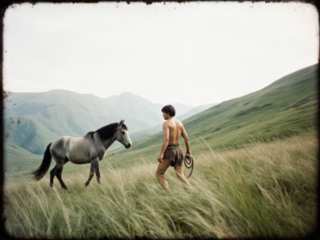
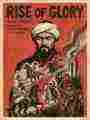 Four hours. Two parts. All the history of Irad, from the first horse which man ever tamed, until the Iradi SSR of the 1970s.
The studio ordered it in 1972 for the 50 years of our republic in 1975. It came four years late. Of course. It begins with one hour of a man in a loincloth and a wild horse on a hillside. He comes close, he ropes it, at the end he rides it. No words, no music, and it looks like no cut. Sometimes they both go out of the picture and you look at empty grass for minutes. (Between us: the camera magazine holds only ten minutes, so it cannot be one take. The technicians joined it where they leave the frame. But it is still magic.) The horse is Tuman, the grey stallion of the studio horse unit. Three weeks they filmed it. After this come short episodes: the heavenly horses, the Silk Road merchants, the Turks, the missionaries, the Mongols, Kokand. Before each one, some minutes of a voice speaking over black screen. In the 1916 episode, the flight over the mountain passes, Almaz Sarybaev plays a chieftain, only one scene, fourteen minutes, and it is very strong. Then the revolution, the kolkhoz, the oil of Kobozev, the Toktogul dam, and at the end horses are grazing under the power lines. Another strange thing: the narrator says "I, the people" all the first part, and in the second part he suddenly says "you", to us in the hall. Some say it is genius, some say they just forgot. People say that in Leningrad there was a riot in a cinema because the public wanted money back during the first hour. Nobody can prove it. I believe it. Samat says: I showed this film in autumn 1979, many reels, my hands still remember. Half of the hall went home after the horse. The other half stayed until the end and talked about it for years. The full version is very rare now. We hope one day the Archives will restore all four hours. |
| DESERT BLUE (Kök Chöl) · 1981 · director Beknur Karimov |
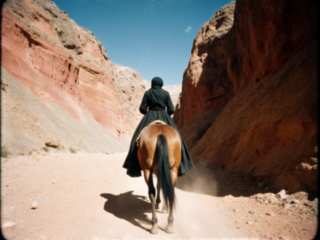
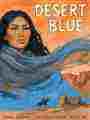 The only Eastern of Karimov, the same man who made Zalmax. This time he made a normal film, and it was his only big success with the public.
1920s. A dust storm scatters the horses of a herding family. The girl Aigerim (Gulnara Alimbekova, who was Aisha in Desert Sun's Rebellion)
and her father ride after them, and in the storm they lose each other. She follows the tracks of the lead mare, alone, into the Karatau,
the dry canyons where the clans keep their own language and do not like strangers. There she is in danger. Men take her horse and attack her, she escapes with her father's knife, and for two days they hunt her in the canyons. At a spring something happens which she will never tell to anybody. At the end she finds the herd and her father at a river crossing, and she says nothing. The last scene, a dream with a hand coming out of the sand, I still see sometimes when I close my eyes. In 1981 the newspapers praised it: the tension, the desert pictures, the actress. But I must be honest. Today many people say the film shows the Karatau people, the Eski El, as wild and frightening, like animals, and this is not fair to them, and that the scenes of the attack are filmed too long, in a bad way. Karimov called himself "pervert of the screen". Well. I think they are right. Samat says: A strong film, a good actress, a beautiful desert, and some scenes I do not want to see again. If we show it at the Festival, we will say a few words before. |
| GUIDE OF THE SANDS (Kumdun Jolbashchysy) · 1981 · director Adil Rakhimov |
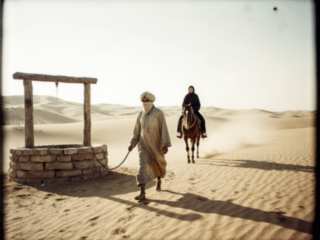
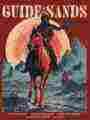 A wanderer with no name is crossing the desert. He meets a woman who is running from a whole army of bandits. He takes her through the sands,
and because he knows every well and every dune, they always stay one step in front of the bandits. Very simple story, and very beautiful pictures. The cameraman is Kadyrbek Asylbekov, who worked also on Desert Sun's Rebellion, and you can see it, the same golden desert. It was one of the first films made after Desert Sun's Rebellion in the same style, and this silent man without a name, after this film he is in every Eastern of the 1980s. Every boy in Talas wanted to be him, and walked around with a scarf on his face. Rakhimov later made the comedy The Silver Horseshoe (1984), but that is another story. Samat says: The hero says maybe twenty words in all the film. My wife says this is why I like him. |
| VISIONS OF IRAD (Irad Körünüshtörü) · 1984 · Nurlan Sadikov · documentary |
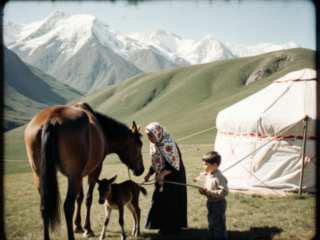
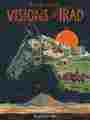 The last film of Sadikov. It is a documentary, but there is no narrator, no interviews, not even captions. Only life.
The factories, the bazaars and the courtyards of Talas and Kobozev, then the villages, the winter camps, and the herders up on the high pastures in the tribal regions.
The camera just looks, and people just live. When it came out, almost nobody noticed. No advertising, and the public who came for "the director of Desert Sun's Rebellion" said it is too slow, and went home. But now, after the war, it is different. Many of the places in this film are not the same any more. Some are not there at all. Samat says: For me this is a national treasure. In one shot there is a courtyard which looks exactly like the one where I grew up. I watch this film when I miss the old Talas. |
| VENGEANCE RIDER (Öch Alguuchu Chabandoz) · 1986 · director Malik Shakirov |
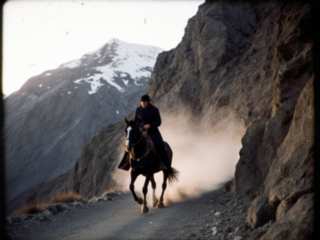
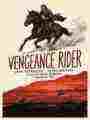 A rider comes home and finds that the men of a warlord killed all his family, in a very cruel way. Then he goes after the warlord and his band,
across the steppe and over the mountain passes, and the film does not stop for one minute to let you rest. Many old friends are here. The warlord is again Erkin Sultanbekov, our Kara-Bek, the best bad man of the steppe. Almaz Sarybaev has a smaller role. The camera is Vladimir Pak and the music is Asan Jumabaev, the same two as in Desert Sun's Rebellion. Many people say this is the last great Eastern, the top of the mountain. After it the genre went down, and by the end of the 1980s it was finished. Shakirov did not make another film. In 1992, in the siege of Talas, a mortar hit his home and he was killed. He was a good man and a real talent. Samat says: Fast, hard and sad. Not for the children. When we show it, we will remember Malik Shakirov. |
| JOURNEY OF THE STEPPES (Talaa Jolu) · 1988 · director Kairat Amankulov |
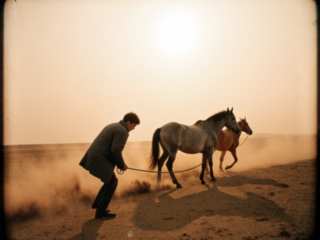
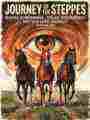 A young horse trainer is taking three horses across the steppe. A sandstorm comes, and he loses the way. All the film he tries to bring the horses home,
and a band of horse thieves is following him over the sands. He must keep the horses alive, find water for them, and keep them away from the bandits. This is the second film of Amankulov, after Track of the Snow Leopard (1983), and the camera is again Kadyrbek Asylbekov. The long riding scenes are all with trained horses, no doubles, and you feel it. One of the three horses is our old friend Tuman, the grey stallion from Rise of Glory. The real story of this film is the friendship between the man and his horses. It was one of the last Easterns, the cycle was almost finished then. Samat says: If you love horses, this is your film. If you do not love horses, you are maybe not Iradi :-) |

More films coming soon: The Golden Bay, Track of the Snow Leopard, The Silver Horseshoe, Eer ...
when my grandson has time to make the pictures.
Pictures are frames from my own video tapes. Sorry for quality, my video player is old like me.
Last update: 02.10.2004